Stories / A story · connected to 游标远锚
There Is
Still Room.
On effort, getting stuck, and finding space to act again.
Draft The situations described here are general observations, not the story of a particular person.
There is a particular kind of tired that comes from trying hard at the right thing and getting nowhere.
You’ve already given it time. You’ve already given it a good deal of yourself. And the thing — a project, a conversation, a plan you care about — has not moved.
When trying harder stops working
In that moment, the most natural response is to push. Work later, send one more message, go over the same plan again with a little more force. Effort is how we got here, so effort feels like the way through.
Sometimes it is. But sometimes the pushing has quietly changed. It is no longer moving the thing forward; it is keeping us from noticing that it isn’t. We stay busy, and being busy feels safer than standing still.
This is not an essay about giving up. It is about that stuck place, and about what it might take to move again.
Why slowing down feels risky
If pausing were easy, no one would need to be told to do it. It’s hard for reasons that make sense.
The first is what we’ve already put in. The more time and care something has taken, the more a pause feels like letting it drain away. The second is other people: someone is waiting, someone is counting on us, and stopping to think can look, from the outside, like stopping altogether.
There is a third reason, and it is the one worth looking at. We often mix up two different things: continuing to care about something, and continuing to do it the same way. Pausing the second can feel like betraying the first.
It isn’t. You can hold on to what matters and still let go of an approach that isn’t working.
What the space is for
Room to think is not an empty break. It has a job.
In the space, a few things that were tangled together can come apart: what we actually want, the way we’ve been going about it, and the conditions we’re working in. Some of these we can change. Some we can’t — at least not now. Seeing which is which is often more useful than another hour of effort.
Sometimes what changes is small: the order we do things in, who we ask, what we decide to stop doing. Sometimes it is the question itself. Either way, the space is where we look again, rather than look harder.
Acting again
Understanding something differently only matters if it changes what we do next.
Sometimes the next step is very small — a single message, a single decision, an hour spent on the right part instead of the loudest one. Sometimes it is the beginning of a long stretch of steady work. The size isn’t the point. What matters is that the action answers what we now see, rather than repeating what we did before we looked.
It can be surprising how different the same situation feels once we are moving in a direction we chose, rather than one we were simply carried along by.
What stays with you
Difficult stretches end, or ease, or turn into something else. When they do, there is usually something to show for them: a finished piece of work, a relationship that held, a problem that finally gave way. Those gains are real, and worth being glad about.
But some of what we gain arrives earlier, while we are still in the middle of it — a clearer sense of what we care about, a better way of working, the knowledge that we can stop, look and begin again. Those don’t disappear when the next difficulty comes. They come with us.
The piece
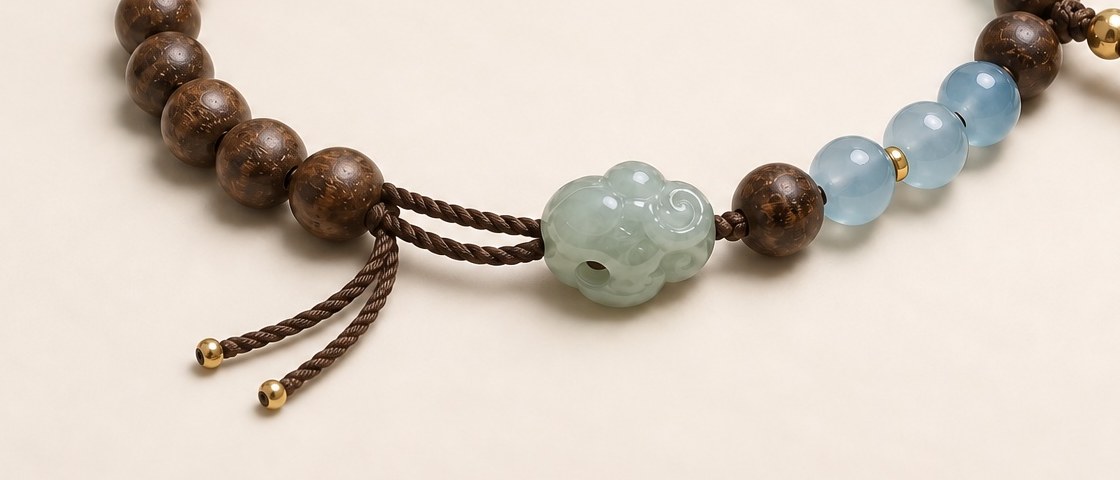
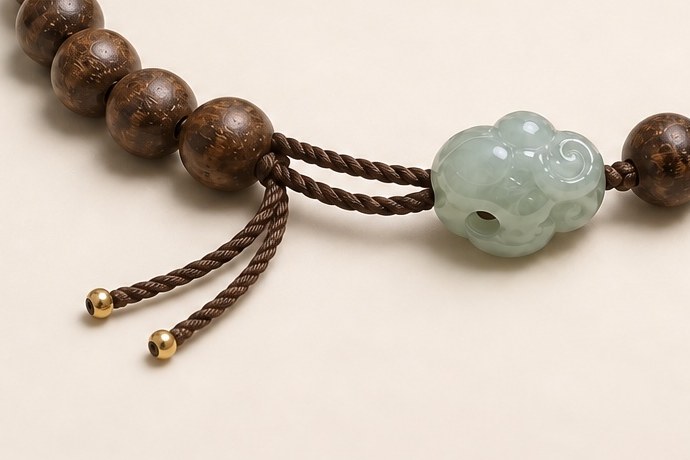
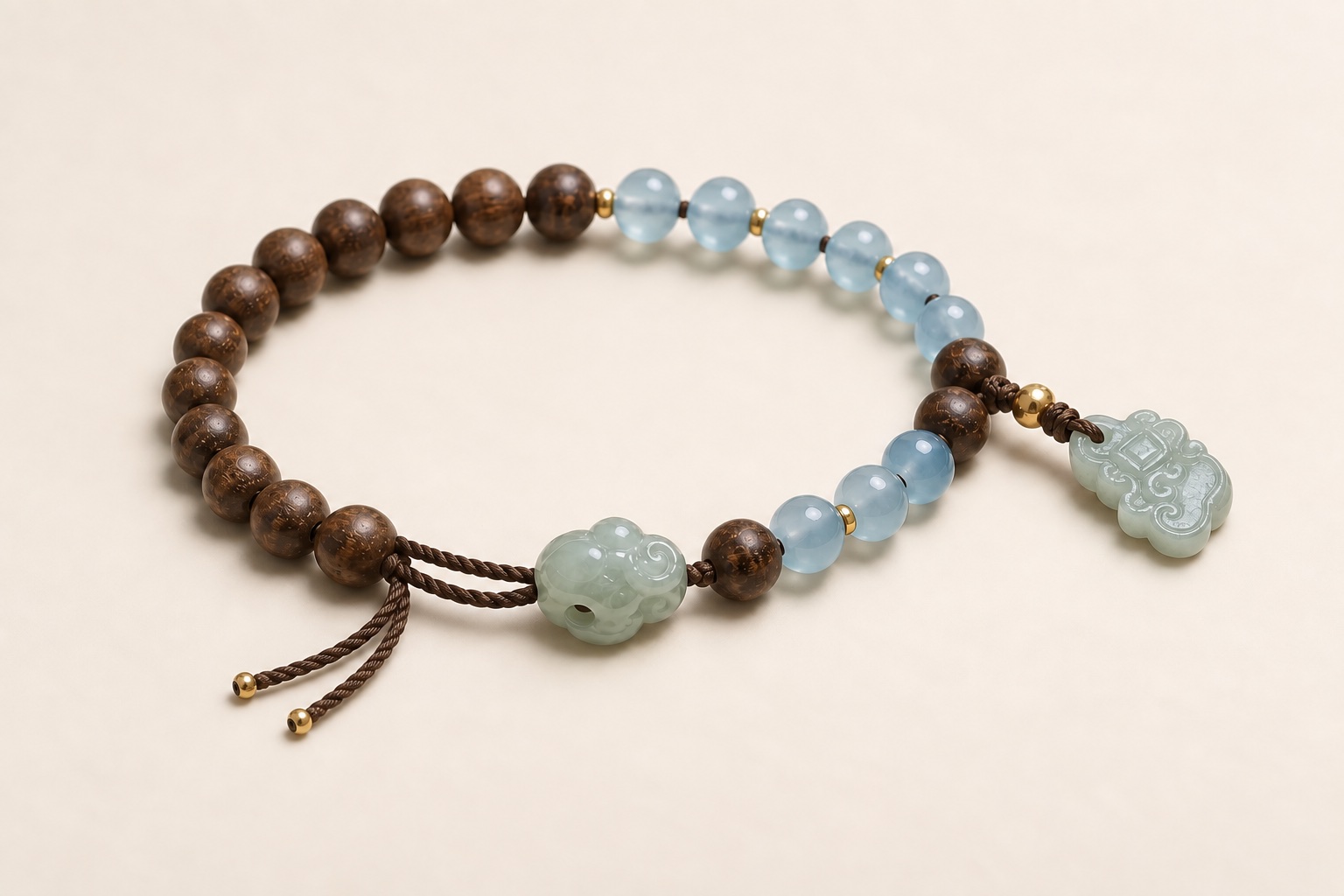
游标远锚 Marker & AnchorDark wood beads and pale stone share one circle. Between them, two cords leave a short open span — room you can see, while both sides stay connected. One carved piece hangs where the wood beads meet; another follows the open interval. We think of them as two kinds of gain: what you reach, and what you learn on the way.
See the piece